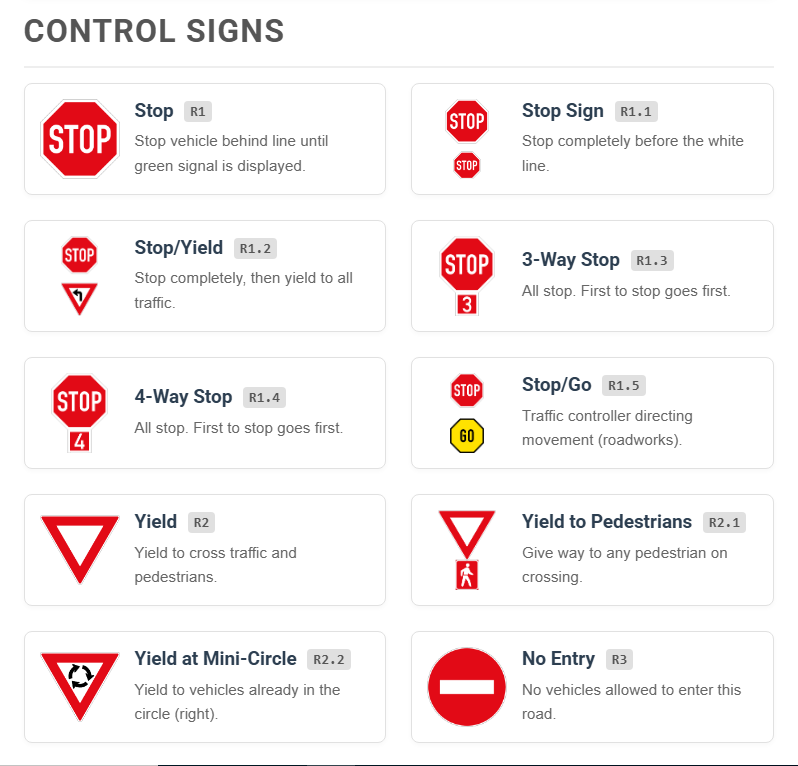
2.4 Right of Way and Yielding Procedures
Understanding “right of way” is about knowing when you must give way (yield) to another road user and when it is your turn to proceed. While specific rules apply at intersections, there are general principles you must follow in all situations to maintain safety and order. The core K53 principle is to never assume you have the right of way; always be prepared to yield to prevent a collision.
General Yielding Rules
You must give way to:
- Pedestrians: At pedestrian crossings, you must slow down and stop if a pedestrian is on the crossing or is about to step onto it. In general, be cautious of pedestrians everywhere, especially children, as they can be unpredictable.
- Emergency Vehicles: You must immediately give way to any vehicle sounding a siren or showing a flashing blue or red light (e.g., police vehicle, ambulance, fire engine). Safely pull over to the left side of the road and stop if necessary to allow them to pass.
- Traffic on a Paved Road: If you are entering a paved (tarred) road from an unpaved (gravel or dirt) road, you must stop and give way to all traffic on the paved road.
- Traffic on a Larger or More Major Road: When roads of unequal importance meet, you must yield to traffic on the more major road.
(Image Suggestion: A series of three small icons: one showing a car yielding to a pedestrian at a crossing, one showing a car pulling over for an ambulance, and one showing a car waiting to enter a tar road from a gravel road.)
The “Stale Green Light”
This is a key defensive driving concept. A “stale green light” is a traffic light that has been green for a long time as you approach it. You should anticipate that it could turn amber (yellow) at any moment.
- Action: When approaching a stale green light, you should ease off the accelerator and be prepared to stop smoothly if the light changes. Do not accelerate to try and beat the light. This shows the examiner you are anticipating potential hazards.
2.5 Towing Regulations
Towing another vehicle or a trailer comes with specific responsibilities and rules.
- Speed Limit: The maximum speed limit when towing is 100 km/h, even on a freeway with a 120 km/h limit. You must obey any lower posted speed limit.
- Connection: If you are towing another vehicle with a rope or chain (a tow-rope), the distance between the two vehicles must not exceed 3.5 metres.
- Warning Flag: If you use a tow-rope, you must have a red flag or cloth tied to the centre of the rope to make it clearly visible to other road users.
- Driver in Towed Vehicle: The vehicle being towed must have a competent, licensed driver in control of the steering and brakes (unless it’s a trailer or being towed with a solid tow-bar).
- Visibility: Ensure your view to the rear is not obscured. If the trailer is wider than your vehicle, you may need to fit special extension mirrors.
- Signage: If you are towing a trailer, it must have a “T” sign displayed on the back. These are typically required for trailers with a GVM over 250kg if they are not fitted with service brakes.
(Image Suggestion: A simple diagram showing a car towing another car with a tow-rope, highlighting the 3.5m maximum distance and the red flag in the middle.)
2.6 Parking Rules
Correct and legal parking is a skill assessed in your driving test and is essential for day-to-day driving. Parking incorrectly can obstruct traffic, create a hazard, and result in fines.
General Parking Rule
The general rule for parking on any public road is to park on the far left side of the road, parallel to and within 450mm (45cm) of the kerb. You must not park facing oncoming traffic.
Prohibited Parking Areas (Where you may NOT park)
You are prohibited from stopping or parking your vehicle in the following places, unless you are required to do so by a traffic officer or to avoid an accident:
- Alongside or opposite an excavation or roadworks.
- Within 1 metre of the edge of the road on the side of an excavation.
- On or within 6 metres of a tunnel, subway, or bridge.
- On or within 9 metres of a pedestrian crossing.
- On the roadway alongside another vehicle (double parking).
- Where your vehicle would obscure a road sign.
- Within 1.5 metres of a fire hydrant.
- In any area where a “No Parking” or “No Stopping” sign is displayed.
- On a freeway.
(Image Suggestion: A graphic showing a car incorrectly parked in several prohibited situations (e.g., too close to a fire hydrant, on a pedestrian crossing, double-parked) with a red “X” over each scenario.)